


Why Are There So Many Chinese Burial Garments in Vintage Stores Overseas?
🌟This article is translated from None of Your Business School (不相及研究所). Founded in 2018, None of Your Business School is a Chinese self-media brand that explores the kinks and odds of China’s ethnographic and chorographic cultures (and subcultures, more often) through curious, humane eyes.
A traveler visiting Japan recently spotted several Chinese burial garments in a vintage clothing shop.
To any Chinese person, they were instantly recognizable: the familiar patterns, motifs, colors and fabric textures. Even if they were burnt to ashes, you’d still know what they were.
Foreigners, however, don’t carry the same cultural baggage. In this trendy vintage shop, the clothes sold quickly. Within days, fashion-conscious shoppers would snap them up and feature them as their latest OOTDs (outfit of the day) on social media.

Today, vintage stores can be found all over the world. Unlike fast-fashion chains that churn out new collections every day, vintage shops sell clothing that has already been worn. Garments preserved for a certain number of years are often classified as “vintage.”
In some stores, you can even find pieces that are decades or more than a century old.
But when Chinese burial garments begin appearing regularly in second-hand stores overseas, the story of how clothing travels around the world suddenly becomes much more interesting.
Some shoppers have found burial garments that are best-sellers on Chinese e-commerce platforms hanging in vintage stores in New York. Others have stumbled across the exact same burial outfit their grandmother was buried in at a second-hand shop in Bangkok.
Chinese burial garments are like an invasive species in the vintage clothing ecosystem. In their original habitat, they appear only among specific people and in specific contexts. But once transplanted into new soil, the cultural taboos and restrictions disappear. The garments return to their most basic identity: clothing. They move effortlessly through entirely different settings.
It is as if someone has opened up the dark web of the vintage clothing industry. The very definition and value of vintage seem to be dissolving.

A blogger who goes by the handle @Zhanglaoxian’er once spotted a bright red burial garment emblazoned with the characters “Fortune, Prosperity and Longevity” in a vintage shop in Budapest. Amid rows of dark, muted clothing, it stood out dramatically.
You have no idea whether the garment once belonged to someone, or how many times it changed hands before ending up there. Soon it will rest on the shoulders of yet another passerby.

The person who buys it may never understand the funerary significance woven into the garment.
This is no longer vintage style. This is tomb style.
For those who understand its cultural meaning, wearing it in 100-degree heat can still send a chill down the spine. It might even save you the cost of running the air conditioner.

Fashion once treated obsolescence as an irreversible process.
But when Chinese burial garments hang openly on the racks of overseas vintage stores, all the usual language of fashion suddenly feels inadequate. What remains is a meditation on mortality itself.
"Outdated? Vintage? This is vintage's grandfather—an antique."
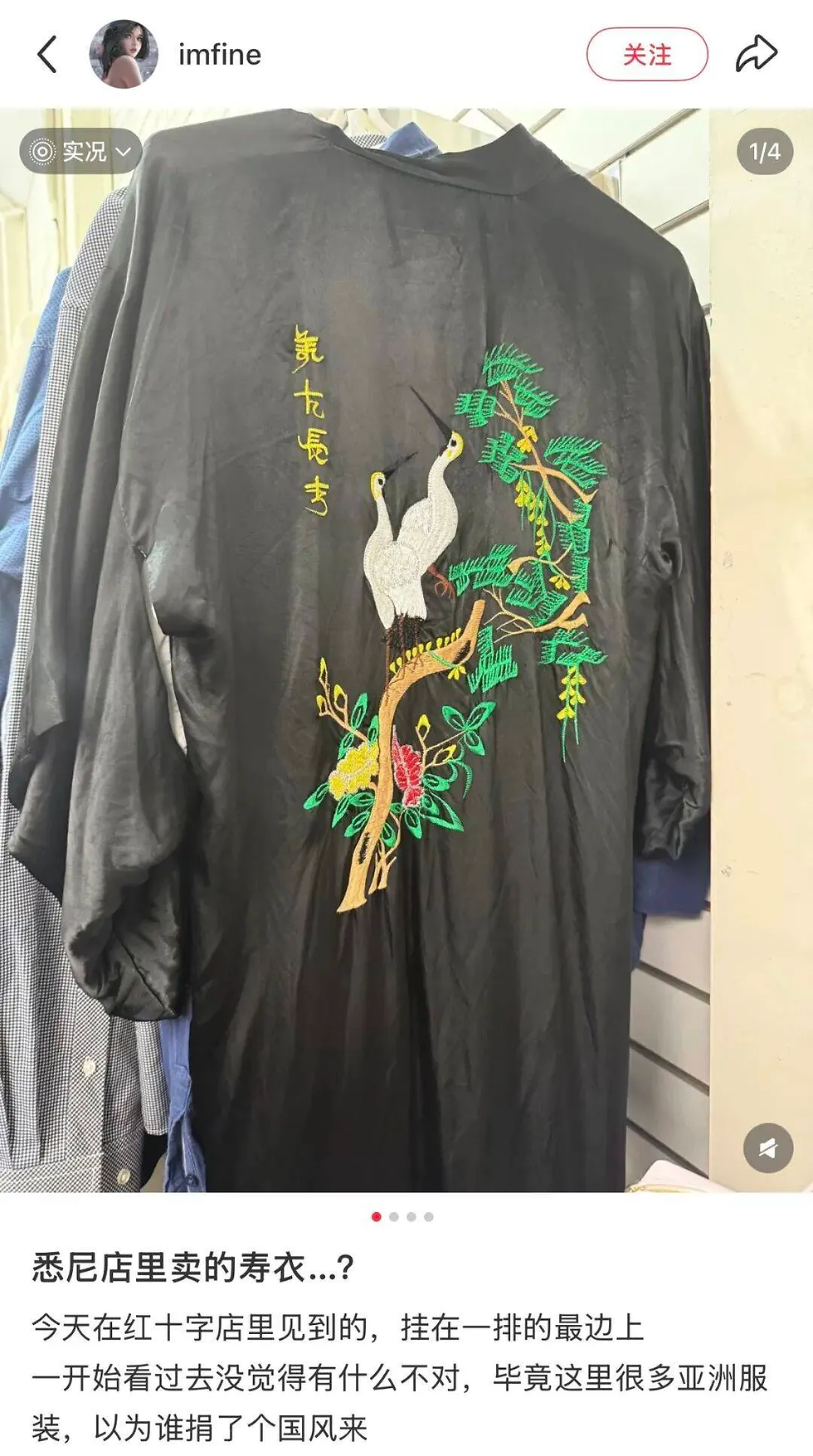
Because many burial garments resemble traditional Chinese jackets, a foreign shopper who falls in love with one at first sight may think they’ve discovered some hidden gem of Chinese fashion.
In a sense, burial garments not only expose some of the myths underlying vintage fashion; they also pierce through time itself.

Who Put Them There?
In reality, it’s not just burial garments.
Huge quantities of second-hand clothing from China now appear on the shelves of vintage stores around the world. This is part of a profound wave of globalization in fashion.

A friend studying in the United States once told me that the moment he felt closest to China wasn’t while eating at Panda Express or walking through Flushing in New York.
It was when he walked into a vintage store and saw the uniform of his former high school.
Instantly, memories flooded back: the school bell ringing in the afternoon, the sound of cicadas, shouts from the basketball court, the smell of food drifting from the cafeteria.
By the time he snapped out of it, a foreign customer had already carried the uniform into the fitting room.

He couldn’t understand how his school’s uniform had ended up hanging in a vintage shop overseas.
Today, a quick search on social media reveals that he is far from alone. Chinese people all over the world share similar moments of confusion and recognition.
More and more clothing from China is appearing in overseas vintage stores. These aren’t merely garments labeled “Made in China.” They belong unmistakably to Chinese social settings and experiences.

In a vintage store in Boston, you might find the latest uniform of the Hebei Economic Security Brigade. The insignia and patches tell you exactly how prestigious the original owner’s position was back in Hebei.
As the Boston store opens its doors to customers in the morning, night has already fallen across the North China Plain. Somewhere, an employee in the security industry may be searching a closet for the coat he wore on assignment last year, unable to find it.
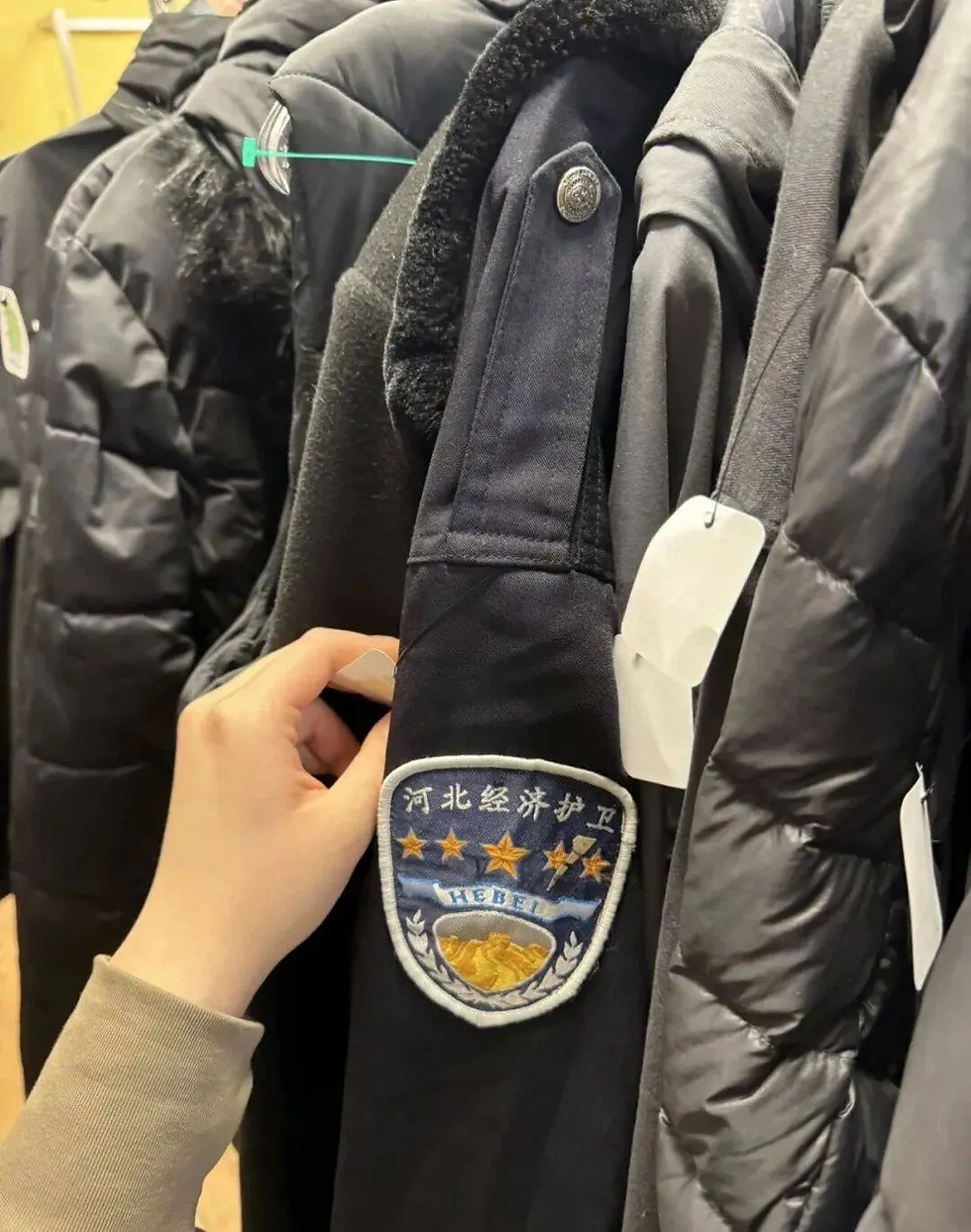
Some people joke that if you’re looking for work in North America, first choose your industry, then visit a vintage store for inspiration.
Put on a chef’s jacket from a Chinese hotel and walk into a Chinese restaurant in Canada. Once the owner notices the grease stains, he might offer you a cigarette before even asking for your résumé.

Delivery-worker vests, sanitation-worker uniforms, military-training outfits, corporate workwear—clothes that couldn’t fetch five yuan on Chinese second-hand platforms can multiply several times in value after crossing a border.
One friend saw a used courier vest from SF Express in a vintage store in Thailand selling for more than the price of a brand-new one on Taobao.
Another shopper discovered that a casual home outfit she had bought on Taobao seven years earlier for 35 yuan was hanging in a British vintage store with a price tag of £7.50.

The Global Journey of Old Clothes
This is a story about the globalization of second-hand clothing.
People move. Clothes travel too.
The moment a garment is stitched together, it begins its own journey.
Some people toss old clothes into the green donation bins found in residential compounds.
What they don’t realize is that these bins are essentially Doraemon’s Anywhere Door.
Once a garment goes in, you have no idea where in the world it might emerge.
If you had told people this story fifty years ago, they would have considered it science fiction.

You never know where the clothes you donate for free will eventually end up.
One person wrote:
“I donated clothes several times through those big green donation bins in my neighborhood. I washed everything, ironed it, folded it neatly and put it in. Later, I was watching a livestream for one-of-a-kind vintage items online—and there was my shirt.”

The essence of vintage is people from different societies and cultures rummaging through one another’s discarded belongings.
Globalization has made everyday goods easier to obtain than ever before. At the same time, it has made it easier than ever to throw things away.
The value of objects has become cheaper because everything is produced too quickly and circulates too quickly.
It’s like the spinning carousel toys of childhood. Every time we wind the spring tighter than before, unaware of how fleeting everything really is.
Only that burial garment, having crossed oceans and continents, completes a true transformation within this grand narrative.


Comments