


Sculpted Suicide: Elders’ Suffering in Rural China

My paternal grandfather and my maternal grandmother have been gone for years. But I saw them again, here in Beijing — hanging from a cracked roof beam.
This isn’t a horror story; It’s a personal, slightly stinging recollection provoked by a sculpture, Elegy of Five Hanged Elders (《吊五人赋》), the work that struck me most deeply at this year’s graduation exhibition at the Central Academy of Fine Arts (CAFA).
I should say up front: I don’t know art. So no fancy critique here.
The artist, Xu Shenglun, took the hidden reality of rural Chinese elderly suicide and carved it out, raw and unflinching, in the country’s top art school. Their pain lay there, undressed, impossible to look away from.

The old woman on the far left: body twisted, joints swollen and deformed. The deep lines on her face told of years worn thin. Her eyes are closed, but she did not go gently — brows knotted, mouth crooked, as though even in death she could not hide her hurt.
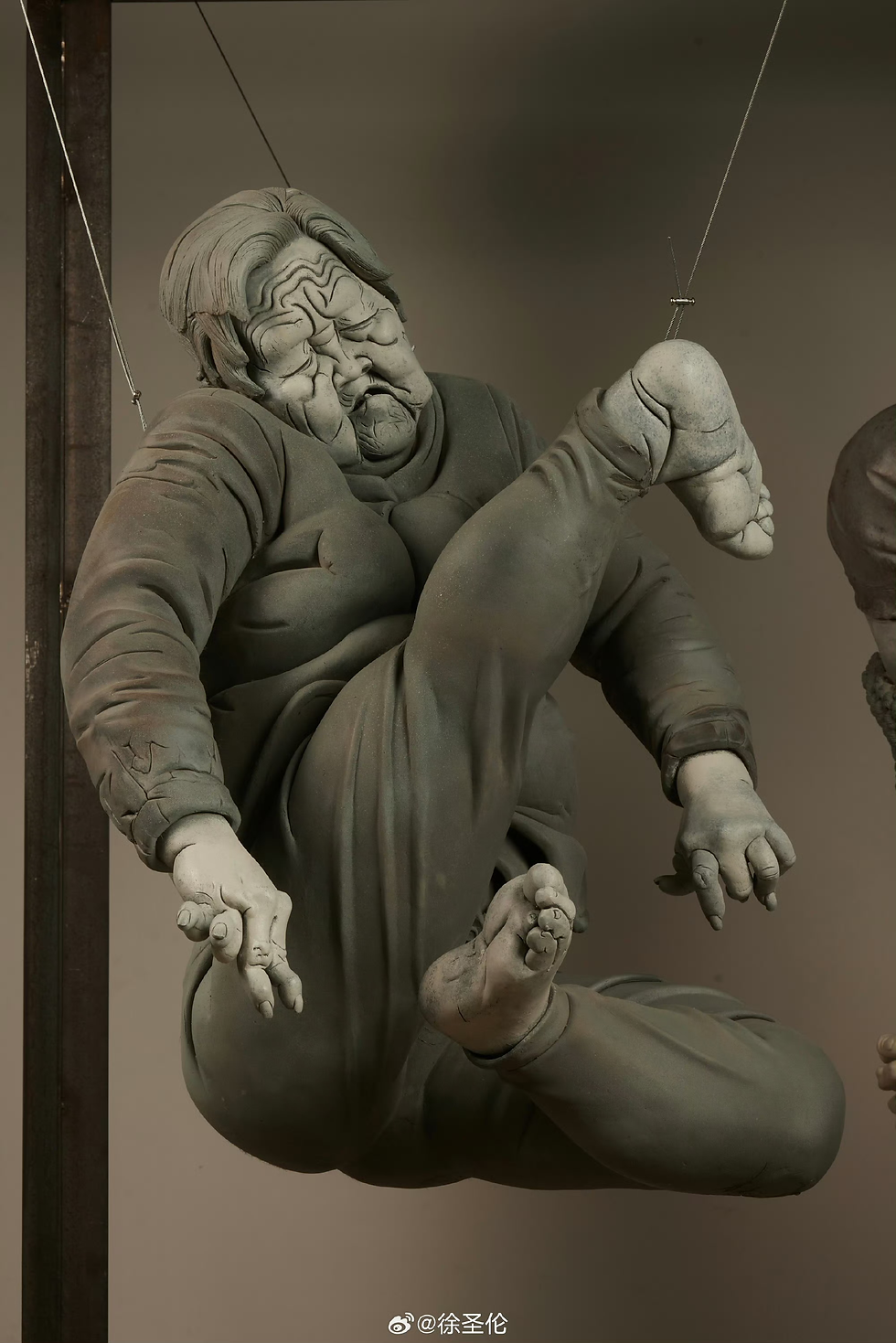
I saw my grandmom in her. The same frame, the same limbs deformed by more than twenty years of rheumatoid arthritis, a chronic autoimmune disease where the immune system attacks the joints, causing inflammation, pain, and joint deformity.
As long as I can remember, my grandmother’s room always smelled of herbal plasters and Chinese medicine. Every time she shifted her body with her cane, it was a tremendous effort. And a day or two before a cold front or rain, her pain arrived more reliably than the weather forecast.
The chronic condition, known as “the immortal cancer,” ate at my grandmom for most of her life. But in 2020, it was stomach cancer that brought her away.
To the right, past the hanging figure with a torn sweater pulled over his face, and another, hunched, in ragged cloth shoes — my eyes landed on a man with hollow eyes and deformed legs.

Those hollow eyes. I knew them too well.
My grandpa spent eight years locked in a wheelchair, unable to take care of himself. I saw those murky, dim, lost eyes countless times — looking out through the stainless steel bars of the kitchen window. His gaze was often unfocused, resting somewhere on the mountains across the road, on the fields he had worked his whole life beneath, or on the paved way at the foot of a slope leading up to the house — the one we always took to come home.
I stood there, looking past layers of gallery visitors in front of the sculpture, staring at the five hanged elderly figures perched on wheat stalks growing from bricks.

The problem of elderly suicide in rural China is just like a chronic illness. For decades, it has hovered there, neither sharply painful nor truly absent to the public. Beside the clamor of China’s bustling cities, it is too quiet. As quiet as those old people must have been, pulling the knot tight in a room where no one heard a thing.
“Starting in 1990, the suicide rate among China’s rural elderly rose sharply and has remained high,” sociology professor Liu Yanwu, who had spent six years doing fieldwork on the phenomenon, told a state-own newspaper in 2014.
“China’s overall suicide rate is declining,” Liu said. “But for the rural elderly, it is increasingly hard to escape this path. Perhaps this is their unique way of diluting and digesting the pain of growing old in a modernizing society.”
In that same 2014 interview, Liu said the situation had reached “alarming and shocking levels.” More than thirty years later, its severity has not faded. Jing Jun, a sociology professor at Tsinghua University who also follows the issue, recently told Sanlian Life Weekly that suicide rates for every age group of rural elderly are significantly higher than for their urban counterparts. In absolute numbers: rural younger‑old (ages 60–74) die by suicide at 1.69 times the rate of urban younger‑old; among the older‑old (75+), rural rates are 1.95 times higher.
The main drivers, Jing added, are economic fragility, poor health, and a lack of emotional support and spiritual anchors.
Looking at those five twisted bodies, I couldn’t help but wonder: during my grandmom’s decades of bone-deep pain and my grandpa’s, did the thought of ending their own lives ever cross their minds?
Maybe, on a rainy night when her joints burned so badly she couldn’t sleep, my grandmom considered ending it.
But for my grandpa, I believe the idea must have had been on his mind for a long time. If he hadn’t been disabled, I don’t think he would have lasted another day in that wheelchair.
Villagers called him “Grandpa Ox,” a name he carried like the plow he never put down. Day in, day out, this quiet man raised a family of four through the lean 1970s, with nothing but a shoulder pole and a hoe.
I spent most of my childhood with my parental grandparents. I loved sitting on his crossed leg as a child while he bounced me like a human swing. I loved it when he lifted me onto his shoulders and walked me through the fields.
In 2014, he fell and damaged his nerves. Surgery saved his life but stole nearly everything else. Those big, capable hands could no longer hold chopsticks. The feet that once stepped onto red soil every morning never touched the fields again.
He had never been a talker. My clearest memory from childhood: him handing me five yuan to buy a pack of Baisha (or White Sand) cigarettes at the village shop, then giving me one extra yuan for snacks. But whenever the quiet man saw me, his mouth would split into a grin, showing teeth stained dark yellow from years of smoking.
After the wheelchair, he grew even quieter. Even when he saw us grandkids, he barely smiled anymore.
Over the eight years he spent in that chair, I moved from middle school through college. My schoolwork piled up, and my trips home became fewer. Each time, he had less to say. At first he would ask something like “How’re you getting on with your study?” Later his hearing faded. Eventually, all he said was: “Oh you’re back.” Whatever I said in return, he seldom answered.
Except once. After a big family dinner, as everyone was getting ready to leave and I was wheeling him back to his room, he suddenly called me by my childhood name and asked:
“Do you hate me?”
I froze. Why would he ask that? After a few stunned seconds, I walked over and said, “How could I hate you?”
His eyes weren’t on me. They were fixed on the blackness outside the window. He went on, more to himself than to me: “Ending up like this… burdening your parents. Spent so much money… Don’t you hate me?”
I couldn’t read the emotion in those clouded eyes. All I could do was clumsily tell him not to think that way, just focus on getting better.
That was the last real conversation I ever had with him.
Then came 2022. He fell again at home. This time, intracranial bleeding. To try to save him would mean high-risk brain surgery.
His two sons argued by his bedside. The older son — a doctor — insisted on operating. He said they had to try whatever they can to save their dad’s life. Besides, what would people say if a doctor didn’t even do his utmost to save his own dad? The younger son — a bus driver — argued against it. He said there was no reason to put their already aged dad through another dangerous operation, to add more pain. Better to let him go.
My grandpa lay there, his face exactly like that old man in Elegy for Five Hanged — eyes hollow, mouth wide open. He seemed to want to speak, but no sound came out. Since his fall in 2014, his life was no longer his to decide. It all was up to his sons.
I sided with the younger son.
Eight years was long enough.
How do you expect a sturdy, hardworking farmer who once fed his family with his own bare hands to face a self that can’t even eat or use the toilet alone? How does a man who was once the pillar of his family continue to carry the weight of believing he’s now the heaviest burden?
2 vs 1. My grandpa escaped that surgery and was sent back home.
Surrounded by the whole family, he closed his eyes and drew his last breath right the next night. He couldn’t speak. He left no final words.

The second his breathing stopped, everyone wept. I couldn’t. Then came the five-day funeral. As the eldest grandchild, I knelt before his coffin, kowtowing at the local prayer master’s command. He kept prodding me to cry. I found myself having to fake it, squeezing out a few dry tears.
Four years later, seeing my grandfather’s face again in that sculpture’s hollow face — and writing these words, the tears finally broke through.
In retrospect, that night he asked me, “Do you hate me?” — that was probably the moment he reached his own breaking point.
If his body had allowed it, I think he would have made the same choice as those five hanged elders. Maybe that very night.


Comments