


Chinese Do Have Beliefs
This is a long-deferred piece. Last December, I traveled to Chaoshan, a coastal region that mainly consists of three cities (Chaozhou, Shantou, and Jieyang, but someone would include Shanwei City as well) in eastern Guangdong, southeast of China, to trace the intricate tapestries of local faith and the folk customs woven into them.

In Chaozhou, one of the region’s ancient seaside cities, I met a local woman who goes by the online nickname “Tide Red.” She chose the name because her Bazi 八字—her elemental destiny—lacks fire (Red), while the “Tide” represents her status as a Chaoshan free spirit: one who drifts far and wide but inevitably returns to the shore. I call her Xiao Hong (Little Red).
I found Xiao Hong through social media, where she conducts what she calls “digital fieldwork” across Guangdong as well as Fujian Province. Our meeting was fraught with logistical tension. It was the end of the month, and Xiao Hong had prior arrangements, but she hurried back to Chaozhou and spared some time to meet me, moved, she said, by my “sincerity.”
We met at a craft beer bar, sipping yellow-skin fruit ales and snacking on suanye—pickled fruits she had brought along. Dipped in a mixture of licorice, perilla, and chili salt, the fruits set off explosions of salt, acid, and heat in my mouth—a sensory franticness that mirrored the raw, emotional depth of her storytelling.

“营老爷” Parading the Deities
In a region often stereotyped for its deep-seated patriarchal preferences, Xiao Hong independently archives data and promotes folk culture, leveraging online platforms to curate a meticulous calendar of religious events across Chaoshan area and Fujian province. The Chaoshan dialect belongs to the Minnan language, and Fujian—sharing this linguistic root—overlaps heavily with Chaoshan in its folkways: a dense fusion of ancestor worship, local deities, and Taoist mysticism.
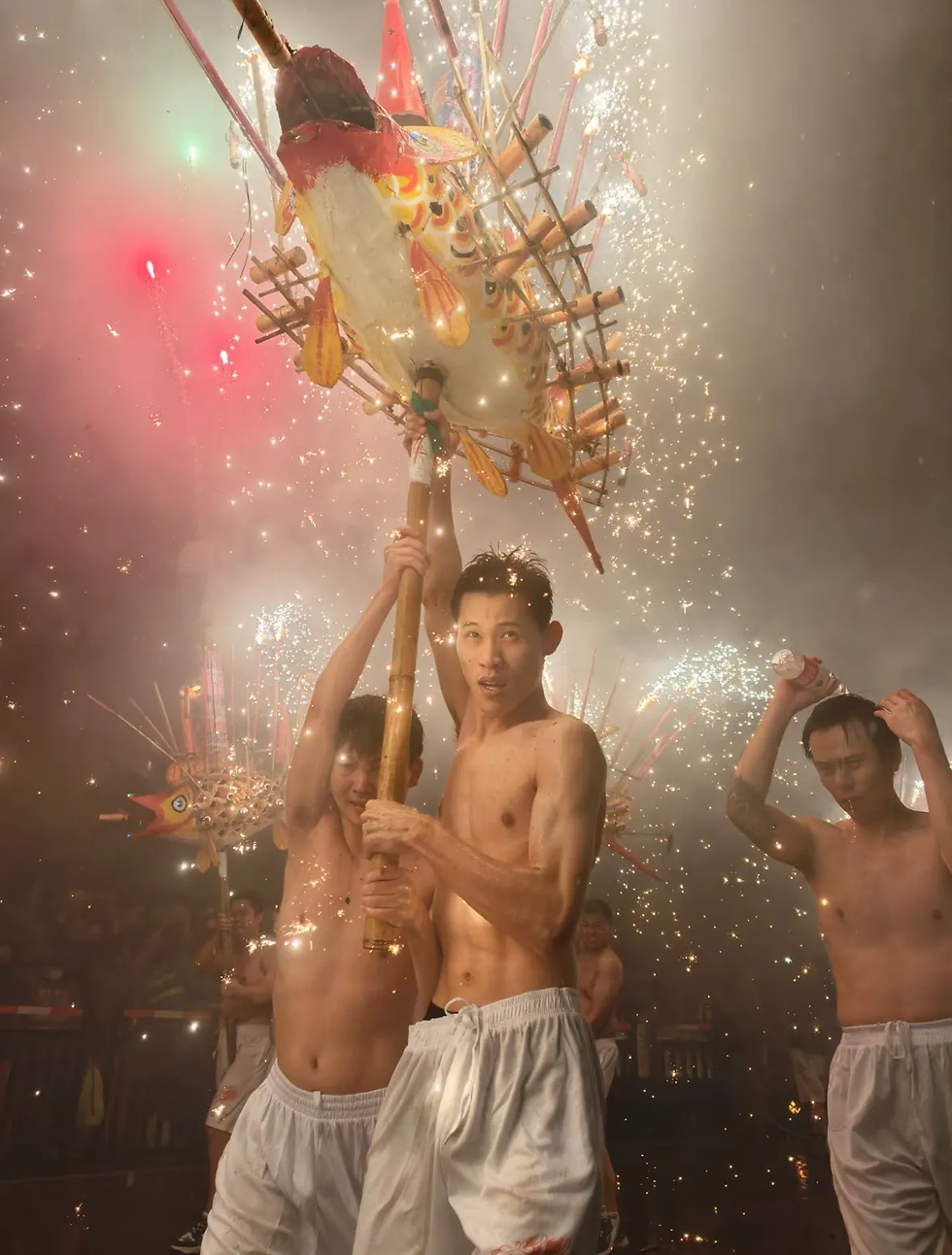
Before interviewing Xiao Hong, I traveled to Kuitan, a town in Huilai County of Jieyang City, to witness a Youshen 游神 or called Ying Laoye 营老爷 in Chaoshan area specifically—a “parade of deities”.
The ritual commenced at 7:00 AM. The main roads had already been closed for the event, yet crowds had gathered aside that early. The entire event was organized by a coalition of Kuitan’s villages; to my surprise, the authority of these local organizers seemed to supersede that of the local government.
“Should the government have any intervention, for the town’s traffic seemed disturbed?” I questioned, but the fact is “the government wouldn’t have the real power in terms of organizing such events.”
In Chaoshan area, nearly every township holds such grand activities around the end of year and the beginning of new year, among which there’s a custom known as Ying Laoye.
In the dialect, Ying suggests “to circle” or “to patrol a territory,” while Laoye refers to the guardian deities of a town or village. The procession is a big spectacle with banner and palanquin teams, Yingge dance, lion troupes, martial arts formations, brass bands, and some others. The primary intent is to invite the “local protectors” out of their temples to survey their domain, theoretically cleansing the land of evil and bestowing blessings of peace and prosperity upon the harvest.
Passersby held their phones aloft, many livestreaming to unseen audiences. When the Yingge dancers finally appeared, the atmosphere reached a fever pitch.
The undisputed soul of the procession, Yingge dance英歌舞 is often hailed as the “War Dance of China.” Its characters are drawn from the outlaws of the classic Water Margin, symbolizing justice and valor. The dancers wear vivid, heavy face paint and wield short wooden batons (Yingge sticks), striking them together with a primal, rhythmic violence that radiates power.
Originally, Yingge dance served merely as a vanguard to clear the path for the deities. Today, however, it has been refashioned as the main character of the parade. This is the “spectacularization” of culture—a reversal of priority driven largely by platforms like Douyin (Chinese TikTok). The dance’s high-velocity visuals and percussive intensity are perfectly calibrated for the algorithm, propelling it from rural corners into the global gaze. Through this lens of spectacle, Yingge has secured government backing and commercial sponsorship, transforming from a vanishing tradition into a lucrative cultural IP.
While wandering through the historic center of Chaozhou City, I encountered a government-sponsored Yingge troupe. The members, both male and female, were almost entirely below 18. They expertly beckoned tourists, performing on the hour, every hour. Their exhaustion was impossible to hide beneath the thick, stylized makeup.
Xiao Hong pointed out a poignant irony: because Yingge dance requires immense physical devotion, the elite education system leaves no room for it. Consequently, the duty of passing the tradition often falls to the so-called “underachievers.” This creates a rift: those with the lived, physical experience of the dance often lack a deep scholarly understanding of its roots, while those with the intellectual capacity to analyze the culture are denied the physical experience of it.
I thought back to the parade in Kuitan town, where I saw a child fall violently from a height during a lion dance. Was he willing to perform this art? Or was he merely a boy who had lost his footing, momentarily dazed by the deafening roar of the crowd?
The Bond of Blood and Divinity
The spiritual architecture of Chaoshan rests upon two parts: ancestral worship (the bond of blood) and the veneration of deities (the bond of divinity). These two spheres possess distinct functional boundaries yet remain tightly coupled within the social fabric. In the local logic, the world of the living is governed by clans and officials; the world of the afterlife is governed by the deities. And ancestors are tasked with the peace of the “small house,” the family, while the deities oversee the “great house”—the collective safety of the community.
Ancestral rites are the ultimate expression of Chaoshan’s ethos of gratitude, designed to fortify lineage and family continuity. These ancestors are known as Jia Nei Shen—“Household Deities”—and their protection is strictly sequestered within the bloodline. Centered around the ancestral hall, the hierarchy of their tablets dictates the social standing and rights of every living descendant in a rigid, pyramidal structure.
Divine bonds, by contrast, possess a remarkable elasticity. To worship the same deity is to become Shen Qin 神亲—“Divine Kin.” This tie transcends geography, stretching across oceans and, now, through the digital ether to the global diaspora. It is a spiritual network far more attuned to the logic of modern social connectivity.
Many Chaoshan deities are historical meritocrats who, in their mortal lives, served the people, such as the Tang Dynasty scholar Han Yu. The locals believe that all things are nurtured by “the Parents of Heaven and Earth”, the supreme authorities in a polytheistic pantheon anchored by regional guardians like the “Lords of the Three Mountains” (San Shan Guo Wang三山国王), and Mazu (妈祖, also called Tian Hou天后), the goddess of the sea.

Communication with these deities is conducted through a highly ritualized “binary” language: the throwing of Shengbei, or moon blocks. This is the most common form of grassroots divination, used to solicit divine “Yes” or “No” answers on matters ranging from business ventures to health problems. The outcome depends entirely on how the two crescent-shaped wooden blocks land on the temple floor.
Sheng Bei (The Positive): One flat side up, one curved side up. A “Yes,” a sign of divine permission or a smooth path ahead.
Yin Bei (The Negative): Two curved sides up. A “No,” signifying disapproval, anger, or an inauspicious timing.
Xiao Bei (The Smiling): Two flat sides up. The deity “smiles” in silence. It suggests ambiguity, a question poorly phrased, or a divine secret not yet ready to be shared.

Xiao Hong shared with me a recent interaction.
“My grandfather passed away in early November,” she said. “But while he was still critically ill, I went to the temple of the Ditou Laoye—the ‘Lord of the Soil’—to ask for guidance.” The Ditou Laoye is a tutelary deity, a celestial magistrate of a specific village or neighborhood.
“Will my grandfather make it past late December?” I asked.
Yin Bei: No.
“Will he live past early December?”
Again: No.
“Will his funeral be in November?”
A smile.
“From a scientific perspective, this is a matter of probability,” she told me, her voice trembling. “But regardless of the math, I simply couldn’t throw the answer I wanted. So I asked one last thing: ‘Laoye, aren’t you supposed to protect us? I know the laws of nature cannot be defied, but could you at least let him go without so much pain?’”
Again, the blocks fell flat-side up. The smiling blocks.
“If you are going on a trip and you ask the deity to keep the assholes away from you, fine—they can handle the small things,” Xiao Hong said, her eyes welling with tears. “But they cannot solve the matter of life and death because he is only a ‘Lord of the Soil,’ not an omnipotent God. We must follow the rhythm of the world. Grandpa was destined to die in pain, and he was destined to die then. It was fixed.”
As a Woman, As a Bearer of Culture
Xiao Hong’s journey recently led her to Shunde in Guangdong Province (not in Chaoshan region), which is seen as the cradle of the Zishunü—the “Self-Combed Women.” These were women who, in a radical act of defiance against traditional marriage, chose to remain single, living in communal “Sister Houses” where they cared for one another in life and performed each other’s funerary rites in death.
The most storied of these sanctuaries is Bingyu Tang冰玉堂—the Ice Jade Hall. Built in 1948 in Shatou Village, it was funded by an 80,000 HKD ($10,216) pool gathered by over four hundred Zishunü working in Singapore and another hundred who remained in Shunde.

“The most traditional place in all of Guangdong is, surprisingly, the birthplace of the ‘self-combed women,’” Xiao Hong’s eyes sparkling. “In this most traditional of places, a group of the most independent women emerged.”
The rise of the Zishunü was tied to the loom. In the Qing Dynasty, Shunde’s silk industry flourished. As women mastered the arts of mulberry cultivation and silk reeling, they grasped something even more precious: economic leverage.
Traditionally, an unmarried woman wore her hair in a long braid; upon marriage, her mother would coil it into a bun. But these women, no longer willing to be pawns in arranged marriages, performed the ritual themselves. They coiled their own hair—a public vow of lifelong celibacy and self-reliance.
When the Industrial Revolution eventually dismantled the local textile trade in the 1930s, thousands of these women crossed the seas to Singapore and Malaysia. There, they became “Majie”— respected domestic workers whose wages fueled the survival of their families back home.
“Yet, when they finally returned to Shunde decades later, they found themselves outcasts, unwelcome in the traditional family structures they had spent their lives supporting.”
In response, they built their own space. When a sister passed away, they would look after her through to the end, and they would pay their respects to the spirit tablets of the Zishunü in the “Sister Houses”.
This is the origin of the practice of setting up spirit tablets in the Bingyu Tang. Consequently, spaces exclusively for women, such as the Bingyu Tang, are rare yet significant throughout Guangdong, including the Chaoshan region.
Scholar He Wenzhen points out that Bingyu Tang became more than a building; it was a life-space that integrated their religious beliefs with individual life journeys, thereby creating the culturally diverse Bingyutang we see today. As a living space for the women, the space embodies their connection to local culture and the significance of their collective identity.
As a daughter of Chaoshan, Xiao Hong’s work as a “cultural transmitter” is often an uphill battle against erasure. In this region, women are frequently objectified, viewed primarily as resources for domestic labor or reproduction.
“When you go out to do fieldwork as a female,” she said, “they don’t see a researcher. They see a ‘piece of meat.’ All the depth—the cultural promotion, the social impact—it all vanishes. You are reduced to something primal. They are the hunters; you are the prey. When you’re the only woman in the room, that’s the feeling that settles in your bones.”
In the Chaoshan social order, the core of the ancestral hall culture is Xu (序)—order. This order provides security for the conventions, while for the modern youth, it is a gilded cage. For men, the hall demands a grueling performance of “face” and networking. For women, the hall is a site of exile. They are the “outsiders,” relegated to the logistical drudgery of preparing offerings, often barred from the inner sanctum of the rites themselves.
This is why “divine kin”—the flexible, elastic bonds of deity worship—is becoming the final tether for the region’s youth. The future of Chaoshan culture may no longer revolve around the cold, exclusionary stone of the ancestral hall, but rather around vibrant, mediated communities born of shared faith.
Xiao Hong envisions a kind of space: Lao Cuo老厝, or “The Old House.” She wants to create a sanctuary for the marginalized—including women, the LGBTQ+ community, and migrant workers—who hold deep affection for Chaoshan culture but feel alienated by its rigid hierarchies.
Her methodology is modern. She uses Douyin (Chinese TikTok) as her primary tool for digital fieldwork, a choice that often invites the “elite arrogance” of the academic establishment. But she finds that, due to the unique nature of China’s censorship of videos and Douyin’s extensive reach into lower-tier markets, temples hidden in remote villages and towns, as well as obscure folk activities (including even somewhat gory scenes such as spirit medium), often appear on this platform.
Between her “digital fieldwork” and her major in Environmental Art, she works as a freelance guide, weaving through narrow alleys on an electric scooter to explain the grammar of ancient temples to tourists. She worries that her English might not meet the “elite criteria” for graduate school, but her resolve is unshaken.
“The knowledge I’ve gained—the political economy of ethnic boundaries, the sociology of folkways—I apply it every day to my work and my digital presence,” she said. “Even if I don’t get that degree, I will never stop learning. This is my life’s work.”

Conferred Titles of the Divine
In the vast reaches of rural China, where the reach of the central state has historically been thin, the gods have often stepped in as the “invisible governors.” This is achieved through a process of ennoblement—the formal recognition that brings a local ghost or spirit into the state’s celestial hierarchy. Xiao Hong identifies three distinct conferred titles: Imperial, Taoist, and Grassroots.
Taoist Conferred Title (Dao Feng 道封) refers to the validation through a formal religious hierarchy, usually Taoist or occasionally Buddhist, providing a theological “license” to the deity.
Imperial Conferred Title (Chao Feng 朝封) means the royal decree from the central court. A prime example is Chaoshan’s “Kings of the Three Mountains,” local spirits who were granted the title of “Kings” by Emperor Taizong of the Song Dynasty for their alleged aid in military victories.
Last but not least is the Grassroots Conferred Title(Min Feng 民封). This requires neither imperial edicts nor priestly endorsements. It is built entirely on the reputation of the god—rumors of miracles and the thick smoke of incense. As the local saying goes, “The deity’s power is measured by the incense they receive.”
“In many temples, you’ll see a plaque at the very entrance inscribed with some characters representing the imperial conferral,” Xiao Hong explained. “The moment you step in, you know this space has been validated by the state. No matter how remote the village, when you see that temple, you immediately perceive the presence of a national system. State authority is perpetually made manifest.”
This is a classic example of what sociologists call “Imperial power reaching the countryside.” Chaoshan is often described as being at “the tail of the province and the corner of the country,” where the emperor is far away. In this context, an imperial title acted as a sort of “franchise license” issued by the central government. By ennobling local deities, the imperial court sent a clear signal to the inhabitants of these peripheral regions: to recognize these state-sanctioned deities was to affirm one’s status as a subject of a unified empire. This functioned as a potent mechanism for both moral edification and political integration.
“If the world of the living relies on the mutual ties of the clan, then the world of the afterlife lies on these deities,” she says. “It was an ingenious stroke of governance—ancient politics achieved through subtle, creeping indoctrination, requiring only a fraction of the manpower usually needed for control.”
By contrast, conferred titles by grassroots carry neither the weight of an imperial decree nor the endorsement of a religious sect. It is a divine status forged purely from local reputation. Yet, this represents the most fundamental of power. As the saying goes: “Whether a deity is efficacious or not, one need only look at the incense of its temple.” If a deity proves “responsive” in matters of local governance—summoning rain or averting disaster—the people will spontaneously erect statues and build temples, with or without an official title.
In contemporary Chaoshan, these ancient forms of ennoblement have turned into a competition for “cultural capital.” As a temple’s grassroots popularity grows, it attracts massive donations. Today, the “orthodoxy” of a deity is less about an ancient emperor’s whim and more about the financial muscle of modern community elders. Those who contribute the most to the temple committee gain the right to interpret the rituals.
In ceremonies like the Ying Laoye, this grassroots consensus often carries more weight than formal law or state authorities. It is the ultimate arbiter for settling village disputes or clan rivalries—a code of conduct rooted in a profound, collective awe.

The Red Line: Superstition vs. Culture
The campaign to eradicate “feudal superstition” in China is not a new phenomenon. While it began with the founding of the People’s Republic, it reached a fever pitch during the Cultural Revolution in 1966 with the “Smash the Four Olds” campaign—an assault on old ideas, culture, customs, and habits that spared almost nothing, from Taoist shrines to Confucian texts.
Today, while folk customs are celebrated as “intangible cultural heritage,” the line between culture and “illegal superstition” remains a sharp political tool. For the general public, the Ministry of Civil Affairs defines “feudal superstition” by its social impact: does the activity disrupt public order, harm health, or defraud the public? Practices like fortune-telling or spirit-medium trances often fall into this category if they lead to “chaos” or injury.
However, for the millions members of the Chinese Communist Party, the standard is far more stringent. Under the Regulations on Disciplinary Actions of the Communist Party of China, about “how to determine the act of organizing or participating in feudal superstitious activities,” there’s a statement as followed—
“Our Party is a Marxist party, and Communist Party members must be firm adherents of Marxist atheism. Participation in feudal superstition is a betrayal of faith at the deepest level of consciousness; it is a manifestation of spiritual decadence and a lack of belief.”


Comments