


Riding in the Wilderness: An Ethnic Border Town in Northern China
Updated: Nov 16, 2025

From October 1 to 8, China was celebrating its National Day and Mid-Autumn Festival — a week-long “golden holiday” that turned the nation into one vast crowd. To avoid the crush of tourists and the dismal sight of “heads upon heads, no scenery to see,” I chose to travel off-season, heading north to Enhe (恩河), a small border town in Hulunbuir, Inner Mongolia, where Russian and Mongolian communities intermingle. Across the Ergun River, Enhe faces the town of Olochi in Russia, two quiet guards staring at each other from opposite banks.
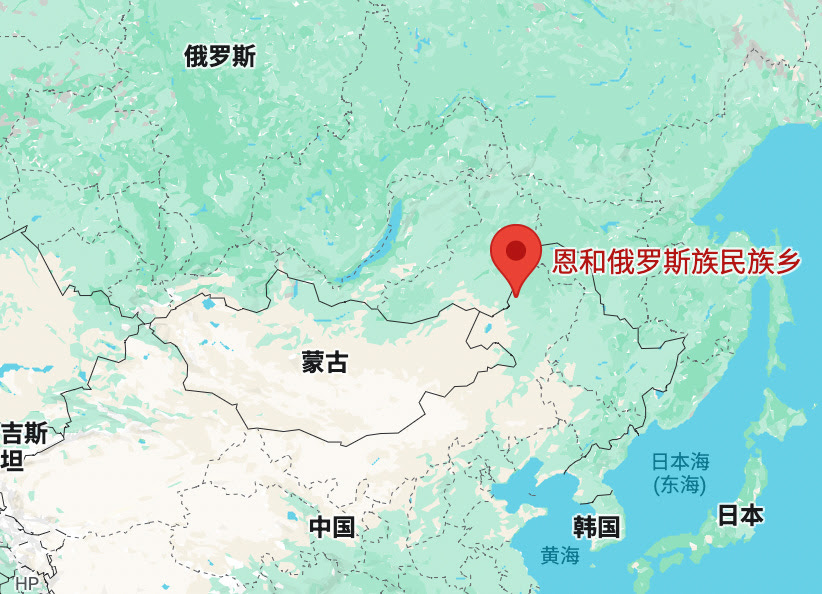
Before I arrived, I’d expected that as the tourists thinned, some businesses would naturally shutter. What I hadn’t anticipated was that they left so swiftly and completely. Almost as soon as the holiday ended, the stores and restaurants all closed.
The entire town was left with only two restaurants and three grocery stores still open.

On October 10, I reached Hailar (海拉尔), an urban district under Hulunbuir — the main jumping-off point for trips to Enhe, Shiwei, and other border towns.
I came with one clear goal: to ride horses across the grasslands. But I also had a quieter hope — that I might have a chance to have a deep talk with local Russians or Mongolians.
That small spark of anticipation was promptly snuffed out the moment I arrived.
The first local I spoke with was a taxi driver named He Dawei. Even for readers halfway across the world, his name would immediately register as Han Chinese. But as himself put it, that wasn’t quite the full picture.
“My father’s Mongolian, my mother’s Han. You could say I’m mixed,” he said with a grin. “But to get the college entrance exam bonus (points), I chose to be Mongolian, on my ID.”
In China, every national ID card lists an individual’s ethnic group. If one parent is Han Chinese and the other belongs to an ethnic minority, the child can choose to be officially registered as either. Because ethnic minorities receive certain policy advantages — including extra points on Gaokao, the national college entrance exam — many families opt to register their children as the minority.
He Dawei’s accent resembled that of China’s northeastern provinces — Heilongjiang, Jilin, Liaoning — which neighbour Inner Mongolia. Their people share more than geography: temperament, food, and humor all lean northeastern.
“They don’t even teach Mongolian anymore,” he added with a self-deprecating laugh. “I can’t speak a word of it.”
Mongolian isn’t the only language fading from public education. During my last trip to Diqing Tibetan Autonomous Prefecture, locals told me Tibetan had also been removed from the compulsory curriculum. The subject vanished from entrance exams; in many schools, Tibetan-language textbooks had disappeared altogether.

At the Hulunbuir History Museum in Hailar, the eleven exhibitions narrate the region’s past — from prehistory to the present — in a supposedly “objective,” chronological way. Yet the underlying message is familiar: national integration.
The Chinese Communist Party has long used that neutral phrase to disguise what is, at its core, a program of cultural hegemony and sinicization — the steady march toward what President Xi so often calls “the irresistible tide of national unity.”
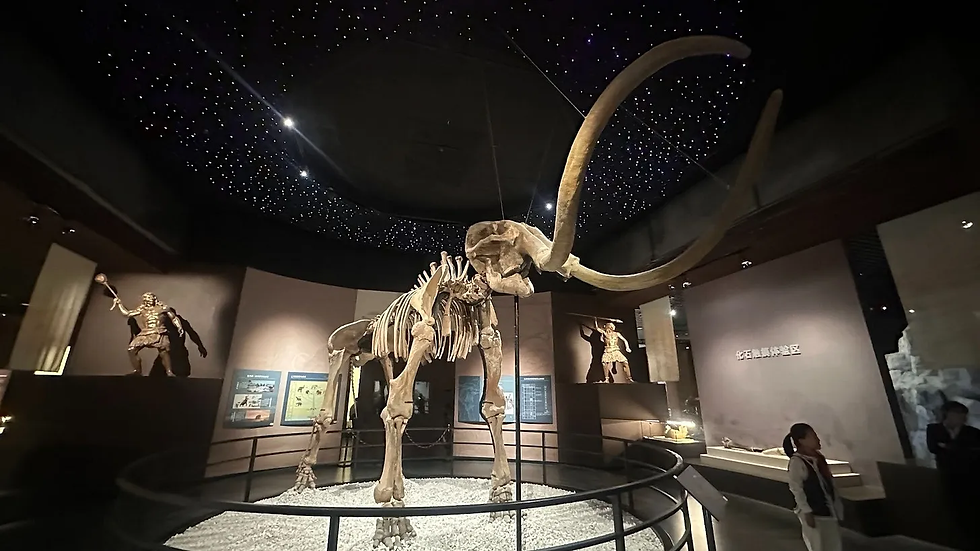
In some galleries, a few Young Pioneers — children wearing bright Red Scarf — served as docents. I was listening to a little girl’s earnest explanation when a boy beside me, brimming with resentment, muttered loud enough for everyone to hear:
“Mom, why do you look so proud when she’s presenting, but so annoyed when I do?”
I couldn’t help laughing. When the girl, “Da Yao,” finished, I gave her a thumbs-up and told her she did wonderfully.
She blushed and murmured a shy “thank you.” The boy noticed this and immediately erupted, stamping his foot.
“Da Yao! I wanted to have a try — why didn’t you let me?”
The little docents’ speeches were scripted, the cadence slightly stiff — with the faint theatricality of a North Korean school pageant — yet beneath the shyness and rote delivery pulsed something genuine: pride, vitality, a glimmer of self-recognition. Not the hollow slogans of a distant leader, but a more instinctive affirmation — a child’s sense of belonging.
Watching them, I felt an unexpected chord of kinship. These children, dubbed the “successors of the Party,” were bound by the same red scarf that once tethered my own childhood soul.
The Game for the Brave
In recent years, Inner Mongolia — blessed with its vast open lands — has seen a boom in what people call riding camps: short, intensive programs that promise to take novices “from zero to galloping” in just five to seven days.
Unlike traditional horseback treks, these camps offer all-inclusive packages — accommodation, even professional photography. Unsurprisingly, they’ve become magnets for urban 牛马 (cattle and horse, a meme referring to the labor), weary souls who dream of escaping the concrete jungle to feel the northern wind sting their faces across the endless steppe.
They come for that one perfect photo — wind in their hair, reins taut, horse mid-stride — a social-media trophy meant to inspire envy in those still chained to office desks. For many, that fleeting sense of freedom is a kind of life-support: a memory to be sipped slowly through the long, dull hours back home.

On the way to Enhe, I sat in the car with Tianxiang, who runs one such riding camp. We chatted idly to pass the time.
“Some locals really don’t like us southerners,” Tianxiang said, keeping his eyes on the road. “When I first got here, nobody had any sense of service. They were rude — downright hostile. But we brought business, right? We worked with them, helped them make money. Still, some people didn’t appreciate it.”
I looked out the window and said nothing.
Tianxiang is one of those self-sponsored travelers — the kind who has roamed half of China, paying his university tuition and travel expenses with his own hands and grit. It’s a kind of southern genius, this instinct for hustle. I admired him for it.
And yet, between us ran a quiet divide. He had a habit of reminding me — gently, insistently — that a young woman traveling alone, especially in remote places, was taking an enormous risk.
He told me a story in Nepal: “I was about to leave my guesthouse one morning,” he said. “There was a girl sitting silently in the lobby. I went over to say hi — and suddenly she just threw her arms around me and started crying.”
He paused for effect. I as a woman, had the instinct of what had happened.
“She’d been dragged into an alley and gang-raped by locals,” he finally said.
I thanked him for his concern with kindness. But those in positions of advantage often mistake their dominance for guardianship — they “teach and protect” under the banner of benevolence, while quietly encroaching on the space and agency of those deemed weaker. All, of course, “for your own good.”
So I said to him, lightly but firmly: “There are plenty of cars on the road — should I stop going out just because I might get hit?”
Horseback riding, after all, is not without danger. Every adventure carries risk; one can only work to minimize the odds of calamity. In that sense, I agreed with my instructor, Xin, who liked to say, "This is a game for the brave.”
Because my travel schedule was tight, I had to master the basics quickly — at least the posting trot: rising and sitting in rhythm with the horse’s stride, the most fundamental skill in riding.
It sounded simple enough. In practice, it was a challenge. Especially since my horse turned out to be the sort that “sizes people up before cooperating.” The moment I mounted, it tested me with a show of defiance — halfway through the trail, it would wheel around and head back, or else veer west when I pulled east.
Watching this “rebellious son” toss his head and resist the reins, I couldn’t help feeling a twinge of irritation, even suspicion: perhaps this gelded horse still harbored a kind of gender bias.
Xin was a patient man — perhaps all horse trainers must be. Before I mounted, he’d warned me, “Whatever you do, don’t scream. It’ll only spook him. Horses can sense your emotions. No matter what happens, stay calm. He has to trust you.”
I nodded, looking at him — cigarette between fingers, reins in the other hand, unhurried, self-assured. I wondered how many times he’d fallen off a horse to acquire that ease.
“I even teach Mongolians how to ride,” he added, a flicker of pride in his tone.
Below me, my horse — whom I’d nicknamed “Glutton” — buried its mouth deep in a pile of dry grass, chewing as if the world had ceased to exist. I yanked toughly on the reins and pressed my knees into its sides.
Before we can be friends, he should at least acknowledge that I’m here.
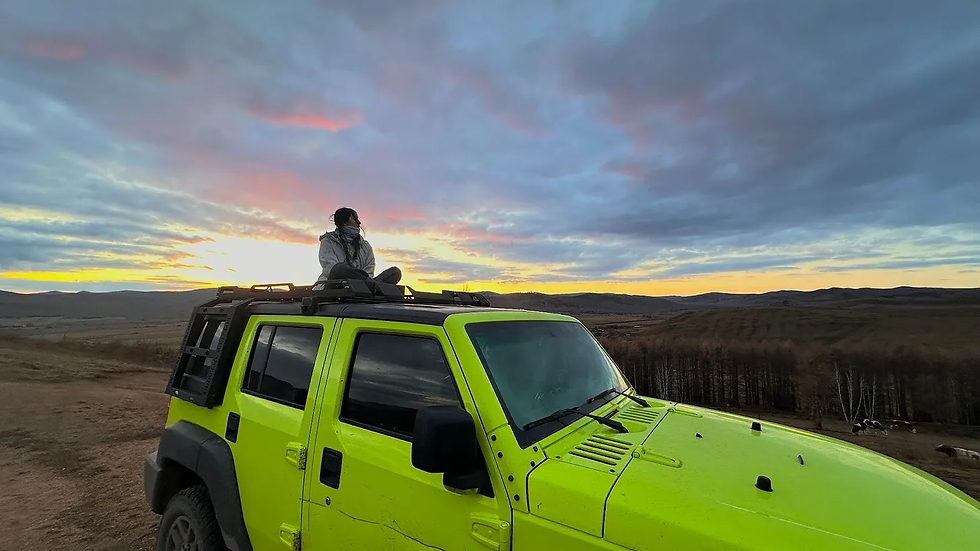
As I mentioned earlier, these riding camps are designed for intensity — short, high-frequency lessons to take beginners to full gallop within a week. But once the tourist season ends, most camps pack up and leave the steppe for new ventures. The horses stay behind, tended by local herders.
Non-locals can purchase property here, but not land — so they often partner with local ranches instead. Tianxiang had chosen to work with Weijia Ranch. At first, I thought it might be run by the Evenki poet Weijia (I recommend the documentary The Last Moose Of Aoluguya); sadly, it wasn’t.
Still, in place of the poet, I met another kind of romantic: a horse trainer everyone called “Zhao Zilong,” named after the legendary general during the Three Kingdoms period of ancient China.
He was a striking figure: broad-shouldered, dark-skinned, wrapped in an old army coat, his coarse hair tied in a short knot behind his head, as if an ancient warrior had wandered into the modern steppe.
Zhao wasn’t much of a talker, but when he did speak, his words carried a quiet, unintentional poetry. One sighed about the fast pace of city life, envying the horses here, free to enjoy the beauty of the vast grasslands and the boundless birch forests.
Zhao said, half to himself: “City 牛马, grassland 牛马 — they’re no different. Handling the city ‘horses’ is the grassland ones’ work.” Then with a faint smile, seemingly referring to someone, “Once this last batch is sent off, these ones finally get a vacation.”
The Biggest Barrier for Business
By mid-October, temperatures in Enhe had plunged to more than ten degrees below zero. By six pm, the sky was already ink-black. The town felt spectral — a ghost settlement where only the occasional traveler paused, and most remaining residents were elderly.
A new hotel was rising on the edge of town. Riding past one evening, we saw a few workers trudging home, helmets tucked under their arms. From a brief exchange, I learned that the project was no small venture: the owner had invested some 300 million yuan, planning a complex of four to five hundred rooms. They were racing the clock to open before the next tourist season.
“It’s good for us,” said the owner of a small cafe nearby, an elderly Russian woman with snow-white hair. “It’ll bring life to the area.”
She had opened the café because, as her daughter once complained, “there wasn’t a decent cup of coffee in town.” The place was barely ten square meters but warm and intimate: curtains and tablecloths hand-woven by the grandmother herself, blending traditional Russian motifs with Chinese knotwork she’d learned later in life.

She always carried her weaving tools with her. “As long as I’m working with thread,” she told me, “I feel calm.”
I would spend my idle hours there, drawn not only by her homemade rhubarb-stem tea, but also by the fact that hers was the only cafe still open that season. Soon she, too, was preparing to leave — to spend the winter elsewhere.
“Maybe when more tourists come, and the big investors move in, the government will finally speed up plans for central heating,” she said wistfully. She wasn’t the only one to voice that hope.
Enhe has no central heating by the government; the nearest city with the system is Ergun. During my stay, the coldest night dipped to -20 °C. Some business owners complained that winter in Enhe was stunning in its own way — crystalline air, white birch forests glazed in frost — but the cost of staying open without heating was unbearable. Few were willing to gamble on a trickle of visitors against certain financial loss.
Technically, central heating in China is provided to regions north of the Qinling–Huaihe line, where average temperatures stay below 5 °C for more than ninety days a year. The heating season runs from November through March — roughly 120 days — powered mainly by combined heat and power (CHP) plants, supplemented by coal boilers or cleaner sources like geothermal and biomass energy.
Rates are calculated either by floor area or by heat metering. For households, the most tangible benefit is cost savings. In Beijing, a 100-square-meter apartment connected to CHP heating costs about 2,400 yuan per winter. The same apartment, heated solely by electric radiators or air conditioners, can run over 5,000 yuan in electricity bills.
For northern tourist towns, the challenge is “busy summers, dead winters.” Central heating could turn that “money-burning black hole” into a fixed expense, managed by a utility company rather than by individuals scrambling to repair their own boilers.
Yet in Enhe, the real ingenuity of surviving the cold lies in the architecture itself. The major dwellings here are Russian-style log houses called 木刻楞, built entirely of solid timber. The walls are stacked from whole logs, with moss packed between the gaps for insulation. Designed for the northern climate, they stay warm in winter, cool in summer.
I lodged in one such house. But clearly, wood alone could not ward off a –15 °C night. The host, Uncle Cheng, had installed radiators throughout the home. Even so, the warmth never quite reached “short-sleeve” level.


Tianxiang told me that because of the cold, most of the camp staff — including the cook — had already left. Only four of them remained: Uncle Cheng, Xin, the Photographer Zhou, and himself. The only thing the four guys ranging from 18 to 45 shared in common was that none was local.
Cheng came from Suzhou, a shrewd, middle-aged man with a natural gift for business. Years earlier, he had spent more than three million yuan buying and renovating his log cabin in Enhe. A former salesman, he had the easy charm of someone who could talk to anyone; though not a native, he seemed to know every merchant in town.
Thanks to his silver tongue, we had breakfast each morning at a restaurant whose owner had otherwise closed for the season. He persuaded her to reopen just for us.
One morning, as we waited for our food, a pair of travelers wandered in and asked if there was anything to eat. The owner — a woman with wild curls and bold eyeliner — waved them off coldly, then brought out steaming bowls of wontons and noodles for us before vanishing back into the kitchen. We ate under the puzzled, faintly resentful gaze of the other guests — half embarrassed, half smug — savoring the luxury of a hot breakfast in the coldness.
Zhou, from Shandong, was the youngest of the group — barely an adult, had dropped off school and was enjoying his gap years. Despite his age, his photography skills are exceptional. I asked where Zhou planned to go after Inner Mongolia.
“Cambodia,” he said. “For work.”
He wasn’t chasing adventure — just for money.
Much of the year, Zhou worked on a small island off Cambodia, shooting promotional photos for resorts and businesses. One project could earn him around 1,200 US dollars.
OK FINE, I could understand his choice then.


Zhou’s grandfather had once been a doctor in Cambodia, and several relatives still worked there, so he had a reliable network. Given China’s recent crackdown on Southeast Asian telecom scams, I was curious. He indulged my questions, but warned me repeatedly:
“Sis, don’t even think about it. It’s too dangerous.”
The island where Zhou stayed was relatively safe — few Chinese, mostly tourists overseas. Even in Phnom Penh, he said, “things get risky because there are too many Chinese.”
There’s an old Chinese internet saying — “The Chinese don’t lie to the Chinese.” It’s a bitter joke, born of too many real stories of compatriots swindling compatriots abroad.
According to Zhou, after the crackdown in Myanmar, many scam operations had simply moved to Cambodia. He described the parks — compounds similar to Myanmar’s notorious KK Park, complete with casinos, clubs, restaurants, even branches of Mixue Bingcheng, one of China’s biggest milk-tea brands.
“But those places aren’t open to outsiders,” he said. “Only the staff can enter.”
Once, while accidentally flying his drone near one of these zones, Zhou crossed into a restricted area — two kilometers too far. That same evening, someone came knocking.
“If my family didn’t have connections,” he said, “I would’ve been taken away.”
Zhou told me about what happened to the people lured or trafficked into those compounds. The newcomers, called piglets, were “trained” through intimidation and abuse until they submitted to work in the telecom scams. One of the methods, he said, was locking them in a cage with a tiger.
Zhou hadn’t seen anyone mauled, but he’d seen the cages and the stains of old blood. It struck me as a story worth pursuing — a subject to dig into carefully, under controlled conditions. I said as much. Zhou’s reaction was immediate, almost panicked.
“Don’t even think about it,” he insisted.
He told me that many of the sex workers in those parks were there voluntarily, from Southeast Asia or even Europe, but others were trafficked and forced into prostitution. Outsiders, too, sometimes joined the abductions — “if they saw a woman they liked, especially the young.”
Then he fell silent for a moment, scanning me up and down.
“Sis,” he said quietly, “if you went there, they’d sell you for up to four million yuan.”

Identities, Complexities
One evening, friends from every corner of China gathered in the guesthouse lounge, drinking Hailar beer and talking about everything and nothing. Naturally, conflict arose.
Somehow, the conversation drifted toward women — or more precisely, the unfairness women face in family and work life back home.
Tan, the eldest among us and mother of two, said she had married and had children only out of filial duty, not desire.
“If I could do it again,” she said, “I’d never give up my career to return to the family.”
Another girl, who worked in Macau, declared that under current conditions, she’d never consider marriage at all.
On gender issues, most men stood firmly on the opposite side from the female group.
Cheng slammed his beer can on the table and shouted, “China has no hope left!”
But alliances shifted as quickly as the topics did. The enemy of one moment became the ally of the next. Within minutes, the room was a blur of laughter and contradiction — the air thick with argument and beer foam.
Soon the talk turned to Xinjiang, Hong Kong, even Tiananmen — some of the most sensitive topics in China – though only in the familiar, exhausted language of the state.
“The crackdown in Xinjiang was necessary.” “I support Deng Xiaoping.”
Tan complained that the “riots” in Hong Kong in 2019, when pro-democracy protests swept the city, and blocked the road to her child’s school, then laughed, recalling how the Polytechnic University students hurled bottles and bricks.
“It was kind of fun to watch,” she said.
Tan was from Shanghai, then moved to Hong Kong for her children’s education, and now holds Australian citizenship. Yet I sensed that she belonged nowhere — that every place she called home carried a kind of estrangement.
Many mainlanders who watched these events unfold have never thought, even just for once, that those so easily dismissed as “reactionaries” were also someone’s children, siblings, friends. They liked to use a single phrase, “they got what they deserved,” to wash over both the cruelty of the aggressor and the suffering of the victims.
It’s much the same with outsiders, unaware of the damage their presence inflicts on local cultures. The Han, the largest ethnic group among Chinese, bolstered by sheer numbers, rarely recognize their privilege — or what minorities must surrender in the long drift toward sinicization.
Usually I keep my political leanings to myself; arguing these things with strangers is futile.
At last, I raised my beer and said quietly, “Let’s just respect each other.”

Despite the charm of alcohol and late-night conversation, I found myself most at peace in the mornings — walking alone through the still, empty streets.
Over the crackling connection, I had a video call with a friend. The coldness made my phone lag, my earbuds quit entirely — though that might also have had something to do with the phone’s brief plunge into a toilet the night before (Uncle Cheng helped to fish it out).
My friend was patient, keeping me company as I wandered without purpose. Then I had time to observe this little town. Enhe, with its blend of heritage like themed hostels and bakeries selling lieba (Далеба), a traditional Russian bread. Some of the ethnic elements, though, felt a bit too eager to please visitors — like the oversized matryoshka dolls planted along the roadside, or the gleaming white carriage straight out of Cinderella.
I rolled my eyes at the sight then, unaware that I’d soon meet the carriage’s owner.
On my last day back to Hailar, the driver picked up a friend along the way — an elderly man with grey blue eyes. He was of Russian descent, and, as it turned out, the proud owner of that same white carriage I’d mocked. In tourist season, it was a hit.
The two men got along easily. Both, in their own ways, were professional drivers. The first, Han Chinese; the second, Russian — yet their accents were nearly identical, an odd harmony that made me smile.
The driver told me he ferried tourists between Enhe and nearby towns. One traveler had once posted about him online; suddenly, his phone was flooded with continuous bookings.
Both men dreamed of catching the same express train — the booming culture-and-tourism industry — yet neither quite knew how to buy a ticket to get on. So I showed them how to advertise themselves on social media. Their eyes lit up, and soon dove into it like explorers discovering a new continent.
Commercialization is not a bad thing from all aspects.
On the day before I set out for Enhe, I wandered through the old quarter of Hailar and came upon a small cultural and creative shop. The first floor sold felt handicrafts and kept a modest bookshelf—a quiet corner of the owner’s private collection. Upstairs, the space was more chaotic: a table stacked with out-of-print books, paintings, and poems scattered as if by accident. From a secluded corner came the low murmur of voices—students, perhaps, discussing a piece of art. The third floor, an airy attic, served as an occasional exhibition space. At the time, it was showing the works of the artist Quanbao.

In his works, Quanbao told of the confusion and struggle of the descendants of nomads within modern civilization. He lamented the nomadic culture amid the tide of the times teetering on the edge of extinction, yet seemed helpless before the unstoppable wheel of development.

It was there that I met Jiang Chuanfeng, the shop’s owner and a painter himself. In his slow, deliberate way, he spoke of shamanic traditions, of the survival of the Oroqen, Evenki and some other indigenous minorities across the grasslands and the Daxing’anling forests.
His stories echoed the unease in Quanbao’s art: that migration, inevitable as it may be, tears at one’s sense of identity—and that without a consciousness of cultural preservation, something far graver awaits: the quiet erasure of civilization itself.
But Jiang ended our conversation with a resolute, calm note:
“The forests will not disappear, nor will the grasslands.”


Comments