


Baking Love in Golden Years: How a Chinese-American Couple Turned Online Romance into a Bakery Bliss in China
- Oct 17, 2025
- 11 min read

It took me nearly an hour to weave through the crazy Tuesday morning traffic rush to reach the new bakery in downtown Changsha from the suburbs. As I stood just steps away from the wooden-framed glass door, the warm chatter and laughter spilled out, drawing me in.
Yet the eclectic signs adorning the right corner of the door paused me, featuring mostly English words with a few in Chinese:
“Changsha meets California”; “You take it easy is our goal”; “Tim and Xiao are ready to take on a new adventure in life”...
“Ting-Ling-Ling…” I opened the door, and the nostalgic jingle of the old-fashioned bell welcomed me inside. Here, I was stepping into more than just a bakery, but also a heartwarming love story of an elderly Chinese-American couple— the one that I thought existed only in romantic fiction – and a niche space where the vibrant cultures of Changsha, a lesser-known city in southern China, intertwined seamlessly with the spirit of California.

Bakery Built out of Love
I came across this newly opened store on China’s Instagram-like app, RedNote, the go-to source for Chinese people seeking fun, food, and lifestyle tips. As a Changsha native, I was immediately intrigued to find that an American has been living in the non-metropolitan city for over a decade, and now cooking authentic American food for spice-loving locals at 69.
Upon entering the bakery, I was greeted by Xiao, the owner and only server that day.
The Changsha native, wearing a pink sleeveless top, with faintly visible muscle lines in her arms, looked to me in her 40s, at the oldest. But actually she’s 57!

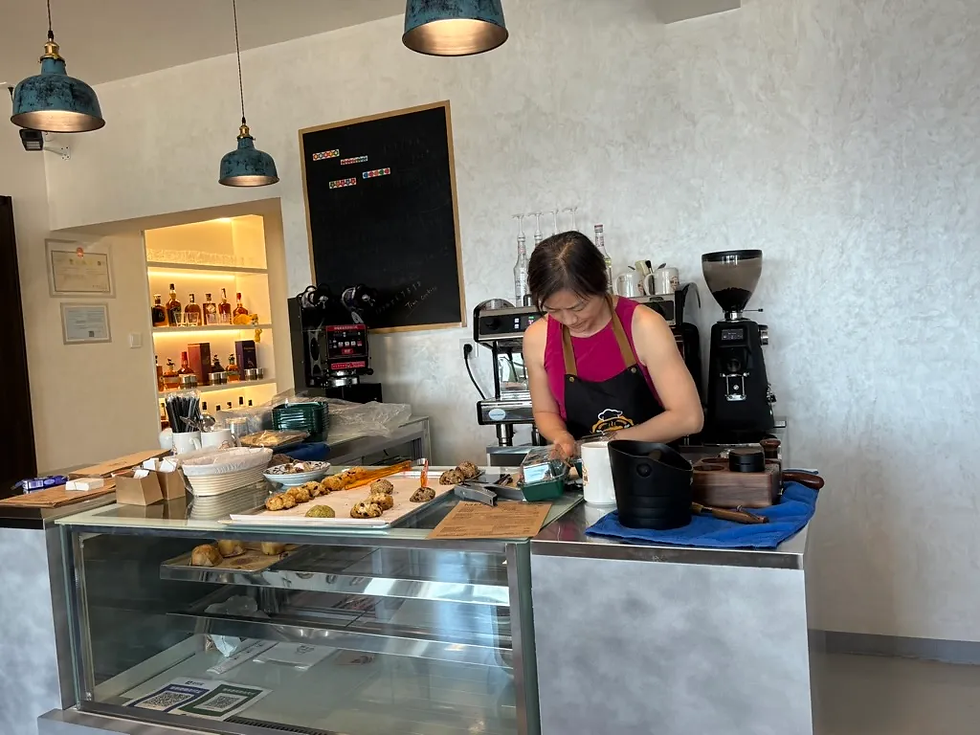
Then, a “hello” in a smoky voice with a broad smile came from Tim, Xiao’s husband and the only chef of the small bakery. He was in the open kitchen, methodically preparing food.
I took a seat at the bar table closest to the kitchen, where a Polaroid of Tim hugging Xiao was proudly displayed right in front of me.

Hearing them call each other “babe” and watching their smiles and sweet eye contact, I — a Chinese woman in my early 20s who had long set aside romance — felt weirdly yet helplessly curious about their story.
Tim and Xiao kicked off their romantic story with a cyberdate when he was in his early 50s and she was in her late 40s, thanks to the Internet in the early 2000s and their open-mindedness.
Before they connected online, Tim had spent most of his life in Scotts Valley, California, where he worked for three decades at a glass firm in Silicon Valley, climbing the ranks to General Manager. Xiao, on the other hand, was a savvy businesswoman in the import-export industry, once ranking third in Hunan Province for her trade volume, she proudly told me.
Despite their business acumen, neither had found the right partner. Tim mentioned that his ex-wife and girlfriend never supported his entrepreneurial spirit, while Xiao’s ex-husband, a Changsha man she described as “rich but less educated,” spent most his nights messing around in Karaokes, massage parlors, and playing Mahjong – what Xiao sees as the “classic trifecta of a successful Changsha man.” [Keen to know more? Don’t miss Biyi’s wild night at “a successful Changsha man’s wet dream” at the grand Wanjiali International Hotel.]
While Xiao managed to break free from her “pointless marriage” at 37, shattering the stigma of being labeled a “leftover woman,” and decided to explore her luck across cultures, Tim, on the other side of the Pacific, was on the lookout for a Chinese woman.
Eventually, these two mature adults found each other online. After months of virtual connection, Tim flew to Changsha to meet Xiao in person and moved to China in 2008, when the US was shattered by the worst financial crisis ever and this seasoned Silicon Valley businessman believed “the US is going down.”
Then, they married on January 9, 2009 – a date Grandpa Tim immediately recalled when I asked him, despite his claim that he’s too old to remember things clearly.

“Tim is a really kind person – he’s gentle to the bone. He’s old-school, not like the typical young Americans today. He’s genuine and very sincere. After all these years of marriage, I’ve never felt insecure for even a second.” Xiao told me, reflecting on their years together, including the days when she was taking care of her cancer-stricken mother and Tim was always by her side, sitting around for extremely long hours that left him with sores.
Xiao told me her mother’s last words to Tim were: “You are a good son-in-law” – in English.

As Xiao recounted one of Tim’s love letters from 17 years ago, when he was about to leave the US for China, the 57-year-old’s face lit up with a youthful glow. It was an expression I’d only seen on the faces of young girls head over heels in love—shy and sweet, with her eyes sparkling with happiness.
“In our relationship, it’s really a two-way street,” Tim told me separately, emphasizing how Xiao’s support stood out compared to previous relationships.
This little bakery, named by Tim, perfectly reflects how his wife Xiao supported her husband’s interests and his wildest business dreams.
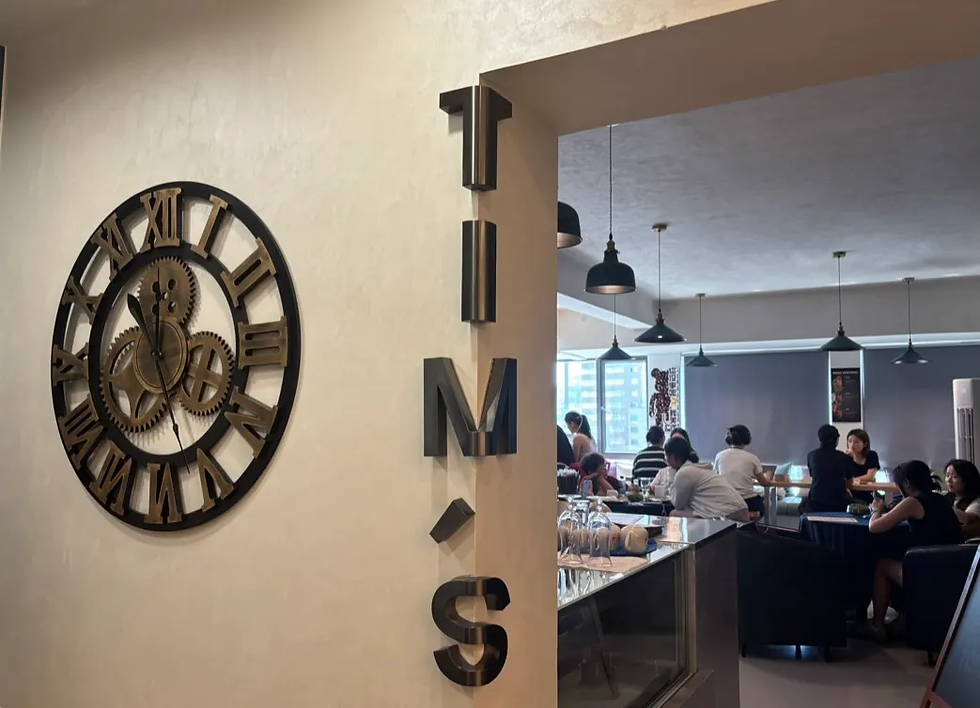
Driven by his love for baking, Tim puts in the hard work and takes his food and customers seriously. He usually stays late until about 10 PM to prepare all the dough needed for the next day, then gets up around 3 AM to pop the proofed dough into the oven, with four timers set just right. By 7 AM, he’s all set to open the store. And of course, Xiao, Tim’s kitchen assistant, is right there with him.

“We want to offer a good product… and we want to offer things to people that they’re not too familiar with.”Tim shared with me. It turns out this aspiration resonates well with the local community.
I deliberately chose a Tuesday to dodge the crowds, but as diners started pouring in from 11 AM and overwhelmed the senior couple, I realized my fellow Changsha locals are way more laid-back than I’d thought!
Sensing their stress, I jumped in to help Xiao take orders. As I served diners who looked to be in their 30s during office hours, I couldn’t help but silently ask each one: Why are you here? Aren’t you supposed to be at work right now ??!!

Food service was unsurprisingly slow that day, not just because there were only Xiao&Tim serving. Unlike most restaurants in China that now use QR codes to take orders, this elderly couple relies on manual ordering—Xiao writes down the meals and relays them to Chef Tim verbally one by one. While this method might take longer for some impatient diners, I personally love this kind of “primitive” ordering method – as one customer commented.
However, even with an extra pair of hands, the flood of orders completely overwhelmed Xiao, and she couldn’t keep track of who had ordered what. So the whole scene ended up like this:
“Hello, the bill, please!”
“Coming! Hmm.. What did you order?” Xiao flipped through her notebook, searching for the right entry. “Sorry I really can’t recall clearly…hmmm, would you mind calculating your own bill? Thanks so much and I’m terribly sorry for this…” Then she rushed off to make another cup of coffee for a different group.
She basically gave up and just let people help themselves with the payment lol. People are fine with that and some, including me, enjoyed this uniqueness of this dining experience – ordering from a brown paper menu, chatting with other diners and the lively owner Xiao while waiting for our homemade dishes to be lovingly plated, and doing a semi-self-checkout with the trust from the slammed boss.

Their official hours are 7 AM to 4 PM, but the couple doesn’t want to disappoint latecomers, so Tim put in some extra time to cook for three girls who arrived about half an hour late.
It wasn’t until 5 PM that Tim and Xiao could finally catch their breath after sending off the young girls. After closing, Xiao frantically called her friends to see if they could find some help. I bet if they had their own kids, they’d be here pitching in.
Xiao and Tim don’t have kids together. Sometimes they do feel a twinge of regret for not having their own little ones, but more often, they appreciate the freedom it gives them to focus on each other.
To me, this charming, bustling bakery feels like their child—born from the enduring love between Xiao and Tim, Tim’s passion for baking, and the elderly American-Chinese couple’s affection for their life in Changsha and for every diner they serve.
California Man’s Love for China
While Tim and Xiao share a smooth love story, Tim’s journey with China had a rocky start.
Before heading to Changsha for Xiao, Tim had several business trips to China as his glass firm started to set up their supply chain with the new WTO member in early 2000s.
On his very first trip to cities like Shanghai and Beijing, China’s two major immigrant cities, and also Zhuhai, one of China’s four earliest special economic zones (SEZs), Tim said he “could not wait to go home.”
“It was just a big culture shock…When people come here, they don’t realize how many people there are and how many people migrate to the cities.” Coming from a less populated rural area in California, Tim was struck by the influx of immigrants in what was then the world’s most populous country. He even turned down his Chinese business partner’s investment proposal in Zhuhai, a decision he now regrets.
However, as Tim made more trips and had more interactions with the locals, he gradually warmed up to the rapidly changing country.
“Because we came so often, we were setting up our supply chain, it just became fun,” Tim said. “(And) I’ve never been mistreated in China by anybody…They’ve always been really friendly. So that’s my attraction to it, you know, besides my wife.” He added.
Back then, China was riding high on optimism after its 2001 WTO membership, rapidly rising as a global player. As China won the bid for the 2008 Olympics in the same year, Chinese people, ready to embrace the guests from all over the world, were generally more friendly toward foreigners than they are today, especially with rising nationalism, which has sparked some xenophobic comments online and even a few extreme incidents offline. That said, most Chinese people are rational and still welcoming to foreigners.
But in Changsha, then a city unfamiliar to many Westerners and even the Chinese from other regions in the early 2000s, Tim was still “more of an oddity.” “Many people would like to stop and want to take pictures with me,” he recounted. And people’s curiosity could be an invasion of privacy sometimes.
That China Tim first encountered is dramatically different from today – a major global power and the world’s second-largest economy, now challenging the Western-led world order.

“I marvel at the way this country has progressed since I started coming.” Tim laid out the improvements in air quality and the marvel of China’s high-speed trains.
“People won’t admit it, but as far as I’m concerned, China’s ahead of the United States in a lot of ways.” He added that his NIO, a Shanghai-based electric vehicle (EV) makercar, is “the sheer hell above” all of the Mercedes, BMW and Range Rover he has owned.
China is now the global leader in EV manufacturing, sales, and technology, driven by government support and a strong domestic market. Chinese brand BYD overtook Tesla to become the world’s largest EV manufacturer, according to BYD’s sales data for the fourth quarter of 2023 released early last year.
This is one side of China, captivating foreigners like Tim and stunning the world with its rapid tech advancements. And there’s another side: tightening social controls, a stubbornly high youth unemployment rate, and other social issues. Just like any other country, China also faces its own challenges at home.
For Tim, though, China feels much safer to live compared to his former home state of California, which he describes as a “pit” filled with homeless people and drug addicts. In California, he owned a gun for protection. However, Xiao has a different impression of the Golden State.
When she first visited Northern California with Tim in 2015 for new business opportunities, she had expected to see a forest of skyscrapers proudly displayed in “the world’s most developed country,” as her parents had described to the younger Xiao. Instead, what she found was a mix of single-family homes and low-rise buildings. Initially disappointed, she soon came to see it as a “dream place” with a “lady-first” culture, chill vibes and warm greetings from friendly Americans.
Moving back to Changsha around 2020 to care for Xiao’s cancer-stricken mother, Tim has fully settled into the city. He navigates its cultural and social nuances largely through Xiao’s perspective, as he hasn’t yet picked up Mandarin or the local Changsha dialect.
Experience Before Judgement
Having lived in China for over a decade while staying connected to the world beyond China’s Great Firewall – an internet control system that blocks access to overseas websites, Tim feels a stark disconnect between the country he knows from the inside and the narratives projected by the outside world –primarily through the media, which he believes to be the “main problem of the hatred that’s going on in the world.”
“(People) formed this opinion about people or their country without ever visiting. And that’s not right.” Tim said.
As someone working in the media industry, I have to admit that bias exists in both news and social media—whether it’s foreigners discussing China or Chinese individuals interpreting foreign worlds. Personally, I believe much of this stems from the conflation of three concepts: a country, its government, and its people. For instance, when people read “China”, many immediately equate it with the Chinese government or the Chinese people. And this misunderstanding runs both ways, as some Chinese may misinterpret other nations through the lens shaped by the Chinese media’s narratives.
While Tim is aware of some societal traits in China – like the ubiquitous surveillance cameras – that could disturb many from the “free world”, he is personally fine with that.
“If I’m not breaking the law… who cares? I don’t care if somebody’s watching me. If they wanna watch me take a shower, go ahead!” He laughed.

Now considering himself a Changsha local and calling China his home, Tim had a message for fellow foreigners: “If you’re gonna come to China, come and see us. You gotta go on the high speed train.. You don’t just go to Beijing and Shanghai, you know, you gotta go to some other places like Tibet… Xinjiang, Yunnan province and stuff like that. There (are) so many more beautiful places.”
And the same applies to foreign tourists to the US – New York, Las Vegas and California are awesome, of course, but there are other “really beautiful places in America,” like Utah, Oregon and Montana, worth exploring, he said.
Hadn’t had to rush off because of other commitments, I really would have loved to chat with them a bit longer and dive into their stories even more.
Pushing open that wooden-framed door at about 7:30 pm, the doorbell chimed again while the couple inside waved me off. Glancing back one last time, my eyes landed on a jumble of sticky notes in the bottom right corner again. The line I took away is:
“Our story goes on.”


Comments